Rank candidates for quantum biosensor testing.

Nebula helps teams building spin-linked protein biosensors decide what deserves bench time first.

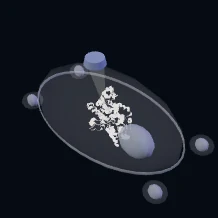
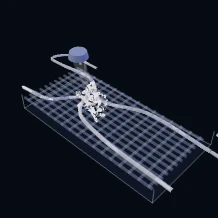
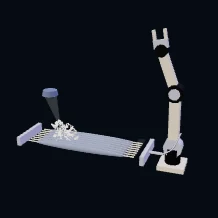
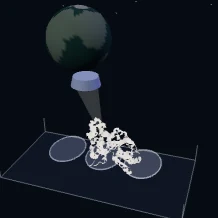
Candidate proteins flow through the Nebula ranking engine and return a bench-priority shortlist.

The bottleneck

The problem is not generating more sequences. It is knowing what deserves the bench.

The missing pre-bench question: which candidates have intrinsic spin-linked sensing potential worth testing?

Conventional method

Generate, filter, test.

Sequence models prioritize fold, expression, brightness and stability. The spin response is usually discovered later by trial and error at the bench.

Nebula engine

Two gates before the bench.

A candidate rises only when it is thermostable enough to advance and spin-active enough to justify testing.

Gate 01 Thermal stability.

AstraDTM and developability signals filter for candidates that can plausibly survive real development.

01 AstraDTM signal

Estimate thermal stability context before a novel scaffold consumes assay and construct bandwidth.

02 Developability context

Use Orbion model signals for fold, expression risk, scaffold constraints and cofactor context.

03 Viable candidate set

Only candidates with enough practical protein context move forward to spin-physics scoring.

Gate 02 Spin activity.

Nebula scores the intrinsic spin physics that sequence-only models cannot infer.

01 Spin mechanism

Resolve whether the candidate contains a plausible spin-active center: radical pair, triplet state, metal site or cofactor.

02 Signal pathway

Model whether the spin event can couple to an optical readout strongly enough to be worth testing.

03 Bench objective

Advance only candidates that pass both gates: thermostable enough to develop and spin-active enough to test.

The proven foundation

Before spin, a biosensor still has to be developable. Orbion's models handle the classical protein layer: fold, stability, expression risk, binding context and manufacturability-relevant liabilities. Nebula adds the spin-linked ranking layer on top.

01

AstraROLE2 and AstraSUIT2

Annotate protein function and estimate target suitability.

Read the paper

02

AstraBIND

Predict likely ligand-binding residues so design workflows can flag sites that should be treated cautiously.

Read the paper

03

AstraPTM2

Predict 39 PTM types across full-length sequences.

Read the paper

04

Developability signals

Predicted thermostability, folding stability, disorder and expression-risk signals, scored before bench testing.

AstraDTM AstraDDG AstraUNFOLD AstraYIELD

The proven foundation under Nebula: selected Astra methods are documented in bioRxiv preprints with reported benchmarks. The spin-linked Nebula layer is the new layer now opening for design-partner evaluation.

The partnership

Design partners shape Nebula's first release.

01

Run on the proven foundation

Start from developability signals predicted by our models before Nebula computes the spin layer.

02

Shape the workflow

Help define the evidence views, ranking logic and shortlist formats real biosensor teams need, with room for collaborative case studies and launch marketing around Nebula as a cutting-edge discovery engine.

03

Your IP stays yours

Your targets, program IP and evaluation outputs stay yours under written partner terms.

04

Early access, heavy discounts

Design partners get priority access to partner runs and materially discounted early pricing for helping shape the product.

The first design-partner window is limited. Book a call now.